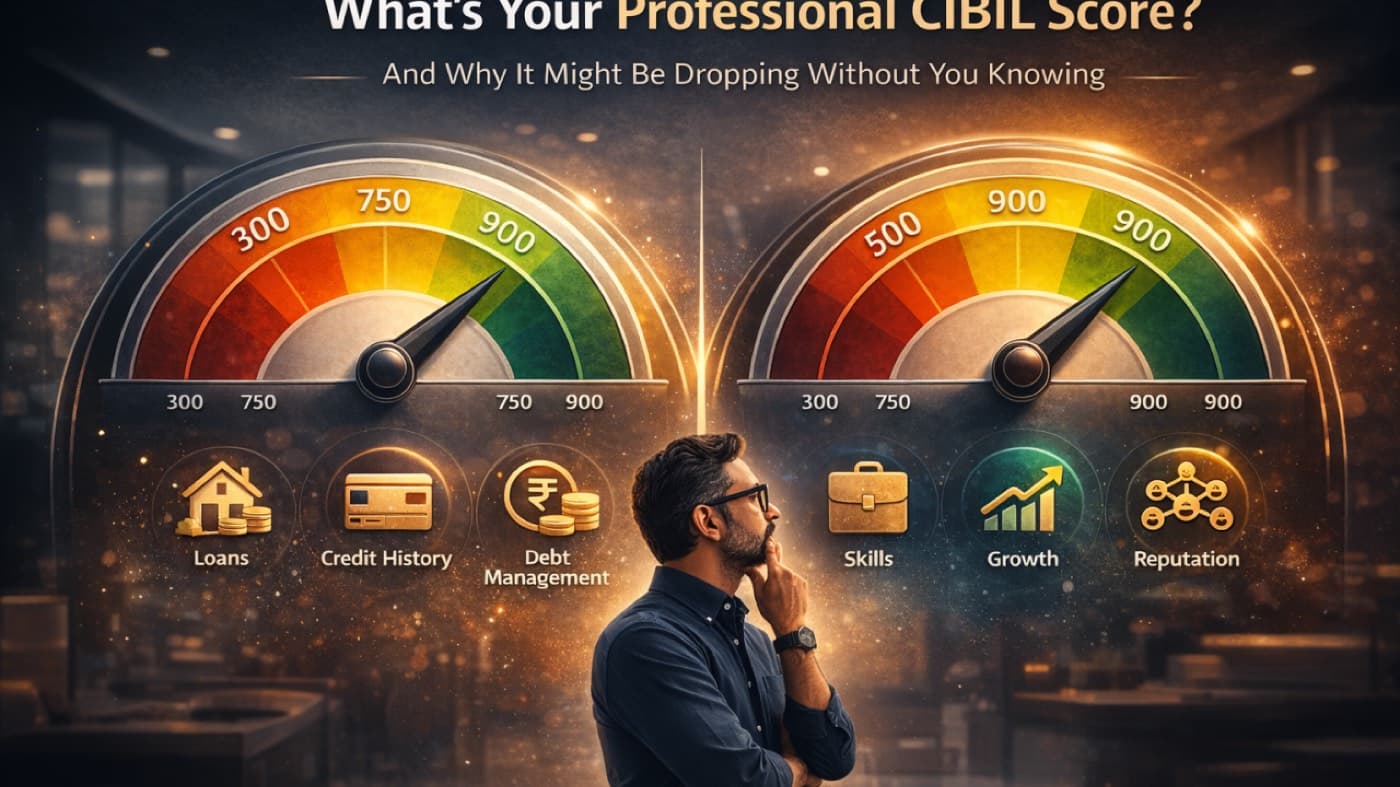
Last month, a mentee of mine — 12 years in IT services, solid delivery track record, comfortable in his "Tech Lead" title — called me with news that hit hard. His company had slashed his salary by 30% and let go of several members from his team. Not because anyone was bad at their job. But because their roles were no longer needed the way they were. He'd been deep in the mobile app development stack for years, with almost no exposure to the AI-powered tools that are now reshaping every stage of the SDLC.
When he asked me how this could happen despite his consistent performance, I told him something that stung but was true: "Your professional CIBIL score had been dropping for years. You just never checked it."
Let Me Explain
We all know the CIBIL score — that three-digit number between 300 and 900 that decides whether you get a loan or get rejected at the bank counter. You miss an EMI, it drops. You max out your credit card, it drops. You don't have a diverse credit mix, it stays low. But pay on time, use credit wisely, maintain a long healthy history and you're at 750+, the doors open easily.
Now imagine the same concept applied to your professional life. Not your resume. Not your LinkedIn headline. Your actual, invisible Professional CIBIL Score the number that determines whether you survive the next layoff, get that call from the recruiter, or become irrelevant in a market that is changing faster than any of us anticipated.
Nobody shows you this score. No app generates it. But every hiring manager, every CTO, every AI-powered screening tool is calculating it whether you realise it or not.
The Five Factors of Your Professional CIBIL Score
Just like the financial CIBIL score has five weighted components, I've mapped out what I believe are the five pillars of your professional creditworthiness:
1. Skill Currency (Weight: 30%) : Your "Payment History"
In CIBIL, payment history is the single biggest factor. Miss one EMI, and it hurts. In your career, skill currency works the same way.
Are your skills current? Or are you still riding on Java 8 when the world has moved to cloud-native, AI-augmented development? Are you still manually writing test cases when AI can generate and execute them in seconds?
Here's the harsh reality from the numbers: Indian IT firms have shed roughly 80,000 jobs in the last 18 months. TCS alone let go of 11,000+ in a single quarter. The roles being eliminated? Traditional testing, manual QA, L1/L2 support, basic coding all the things that AI does faster and cheaper.
Score Impact:
Learning GenAI, prompt engineering, AI-augmented workflows → +50 points
Upskilling in cloud architecture, data engineering, cybersecurity → +40 points
Still relying only on skills from 5 years ago → -80 points
"I'll learn when needed" mindset → -100 points (this is the missed EMI of careers)
2. Experience Relevance (Weight: 25%) : Your "Credit Utilization"
Credit utilization isn't about how much credit you have it's about how wisely you use it. Similarly, 20 years of experience means nothing if 15 of those years are just year one repeated fifteen times.
I've seen professionals with 25 years of "experience" who have essentially done the same project lifecycle management role across three companies. The resume looks heavy. The professional CIBIL score? Thin.
What matters now:
Have you worked across domains or just one vertical?
Have you led transformation, not just maintenance?
Have you delivered outcomes, or just managed headcount?
Score Impact:
Cross-domain experience with measurable business outcomes → +45 points
Leading AI/digital transformation initiatives → +50 points
15 years doing the same role with minor variations → -60 points
No exposure to product thinking, only services delivery → -30 points
3. Role AI-Resilience (Weight: 20%): Your "Credit Age"
In CIBIL, a long credit history is good it shows stability. In your career, what matters is not how long you've been in a role, but how resilient that role is to AI automation.
This is the factor most people ignore, and it's the silent score-killer.
Ask yourself honestly: Can an AI tool do 70% of what I do daily? If the answer is yes, your professional score is bleeding points every month.
Roles at highest risk in Indian IT today: manual testing, basic application maintenance, report generation, first-level technical support, routine project management, standard code development without architectural thinking.
Roles that are AI-resilient: complex system architecture, client advisory, strategic consulting, AI/ML implementation, cybersecurity, and roles requiring deep human judgment negotiation, stakeholder management, crisis handling.
Score Impact:
Role requires human judgment, creativity, strategic thinking → +40 points
Role involves AI implementation or augmentation → +50 points
Role is primarily execution of repeatable tasks → -70 points
"My company needs me" without validating market demand → -40 points
4. Professional Network & Visibility (Weight: 15%) : Your "Credit Mix"
CIBIL rewards you for having a healthy mix home loan, credit card, personal loan it shows you can handle diverse credit. Professionally, your network and visibility serve the same purpose.
Are you known only inside your company? Or does the industry know you? Do you write? Speak at events? Mentor others? Contribute to open source? Have a point of view that people seek out?
I started writing on LinkedIn not because I had a content strategy. I started because I realised that in a market where 80,000 people are looking for jobs simultaneously, the ones who get calls first are the ones who are already visible. Your network is not your safety net it's your credit line.
Score Impact:
Active thought leadership (writing, speaking, mentoring) → +35 points
Strong cross-industry network beyond current employer → +30 points
Network limited to current team/company → -20 points
Zero public visibility or professional brand → -50 points
5. Adaptability Quotient (Weight: 10%) : Your "New Credit Inquiries"
In CIBIL, too many loan inquiries signal desperation. But having zero inquiries means you're not actively in the market either. The sweet spot is healthy, purposeful credit activity.
Same with your career. Are you actively experimenting? Trying new tools? Taking on stretch assignments? Or are you sitting in your comfort zone waiting for the annual appraisal?
The professionals who survived every disruption I've witnessed in 25+ years Y2K, dot-com bust, 2008 recession, cloud migration, and now AI they all had one thing in common: they adapted before they were forced to.
Score Impact:
Proactively experimenting with AI tools in daily work → +25 points
Taking stretch roles outside comfort zone → +20 points
Waiting for company-sponsored training only → -15 points
"This AI thing is overhyped" denial → -30 points
So, What's Your Score?
Let's do a quick mental calculation. Be honest with yourself.

The Wake-Up Call
Here's what I've learnt from personal experience and from watching hundreds of careers in the IT services industry: your appraisal rating and your professional CIBIL score are two completely different things.
Your company might rate you "Exceeds Expectations" while your market value is silently eroding. The appraisal measures how well you did your current job. The professional CIBIL score measures how well the market will want you tomorrow.
Infosys added 5,000 people last quarter. But they didn't rehire the ones they let go. They hired new profiles — AI specialists, cloud architects, data engineers. The old credit was written off. New credit was issued to different people.
Three Things You Can Do This Week
I'm not going to give you a 90-day transformation plan. That's not my style. But here are three things you can do this week:
One. Honestly assess your daily work. What percentage of it can an AI tool replicate? If it's more than 50%, start shifting your mix. Not next quarter. Now.
Two. Learn one AI tool deeply not just a "completed course" certificate on LinkedIn Learning. Actually use it in your work. Build something. Break something. That's how your score goes up.
Three. Make yourself visible. Write a post. Share a project learning. Comment on industry trends. Your professional CIBIL score doesn't improve in isolation — it needs market signals, just like the financial one needs credit activity.
The Bottom Line
Nobody is going to send you an SMS saying "Your Professional CIBIL Score has dropped below 600." But the signals are there fewer recruiter calls, getting passed over for new projects, your role getting "restructured," the uncomfortable silence when you ask about growth paths.
The IT services industry is not dying. But it is fundamentally transforming. And in this transformation, the professionals who actively manage their score learning new skills, staying relevant, being visible, adapting fast will be the ones at 750+.
The rest? They'll find out their score only when they need it most. And by then, rebuilding takes years, not months.
Check your score. Today. Not tomorrow.
What factors would you add to the Professional CIBIL Score? Have you seen your own score shift in the last 2 years? I'd love to hear your story in the comments.
If this resonated, share it with someone in your team who might need this wake-up call. Sometimes the best thing you can do for a colleague is be honest.
First published on LinkedIn.