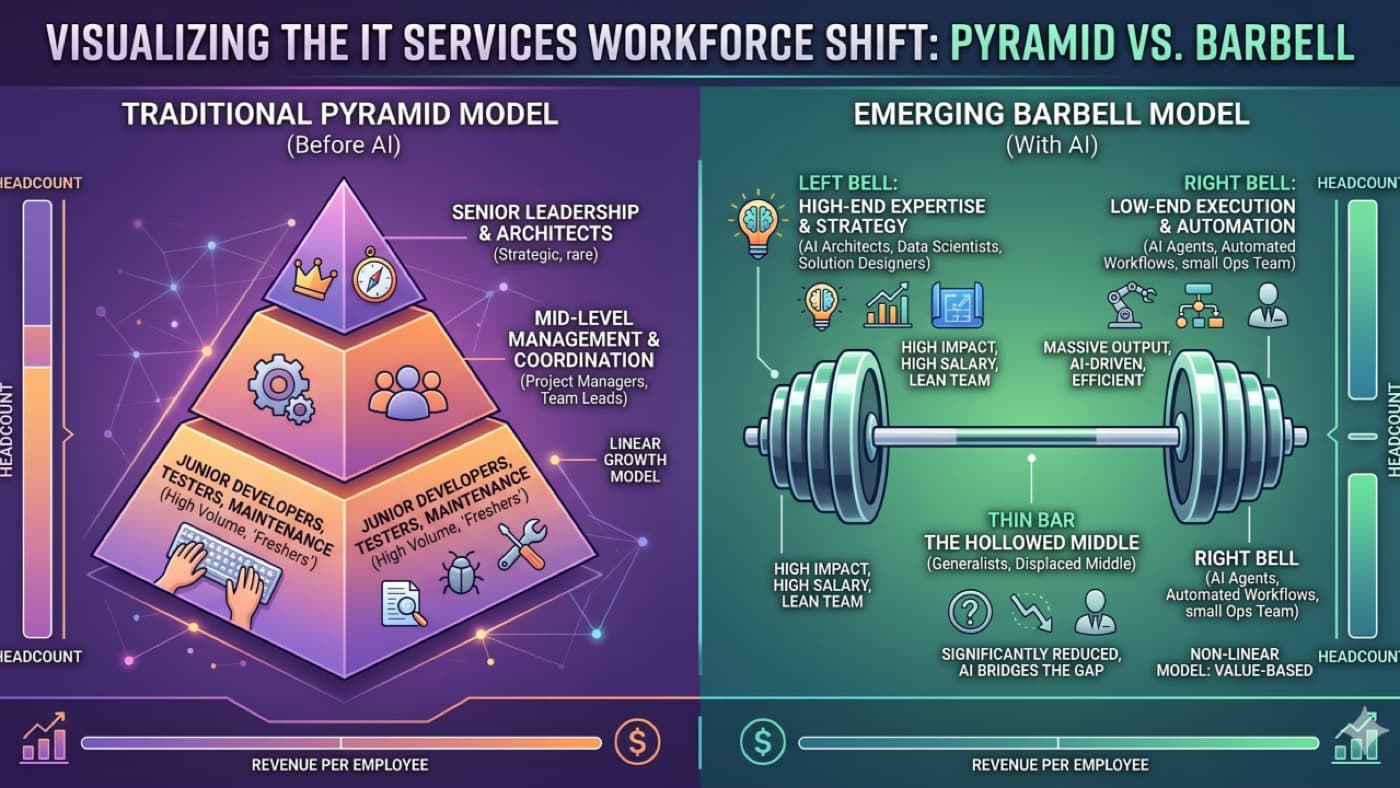
For decades, the growth formula for the Indian IT services industry was simple and linear: to increase revenue, you increase headcount. This created the classic "Pyramid Model" a massive base of fresh engineering graduates executing routine coding and testing tasks, managed by a thick layer of mid-level coordinators, with a few architects at the top.
But that linear equation is officially broken.
If we look at the data, FY2023 was the absolute peak of the pyramid. During the post-COVID digital boom, the top five Indian IT firms added hundreds of thousands of employees. However, the landscape has radically shifted since then. Over a subsequent two-year period, those same top five firms collectively shed roughly 58,000 employees.
Is the industry shrinking? May be not. It is restructuring. We are witnessing the rapid transition from the traditional Pyramid to the "Barbell Model."
What is the Barbell Model? Driven by the practical application of AI and GenAI, companies are hollowing out the middle and concentrating weight on two ends of the talent spectrum:
The High End (Deep Expertise): Aggressive investment in specialized talent AI architects, domain experts, and solution designers who handle complex problem-solving and drive strategic value.
The Low End (Automation & Execution): The massive base of junior developers is being replaced by AI coding assistants, automated workflows, and internal AI agents, which are supervised by a much leaner operational team.
The Hollow Middle: The need for sprawling mid-level management to coordinate large manual teams is evaporating, as AI effectively bridges the gap between high-level architecture and routine execution.
The Metric that Matters: Revenue Per Employee (RPE)
The clearest indicator of this structural shift isn't just the headcount reduction; it is the decoupling of headcount from revenue. IT companies are learning to do more with less.
Recent industry data shows a significant uptick in efficiency. For instance, Infosys recently saw its revenue per employee jump by nearly 5.8% compared to FY22, crossing the $60,000 mark. TCS and HCLTech also reported solid gains in RPE, even as their overall mass hiring drives cooled dramatically.
This isn't a temporary macroeconomic blip or a cautious phase. The deployment of AI agents and LLM integrations in enterprise environments is creating a permanent deflation in traditional, manual IT service hours.
The future of IT services isn't about how many resources you can deploy; it's about how effectively you can integrate AI to drive business outcomes. The firms that master this Barbell structure will thrive, while those clinging to the Pyramid will struggle to maintain their margins.
How is your organization adapting to this structural shift? Are you building the right capabilities at the high end of the barbell? Let's discuss in the comments.
First published on LinkedIn.